Campaign Operations
Part of Email campaign calendars and frequency
Coordinating promotional sends with service messages
Service messages tell customers what they need to know about a transaction or account.
Service messages explain a transaction or account, while promotional messages ask customers to consider an offer. Service notices can include regulatory and compliance notices, fraud alerts, system-wide updates, outages, maintenance windows and urgent security warnings.
Place both purposes on one planning view so a marketing send does not arrive at a confusing or insensitive moment. Keep service and promotional messages distinct in the plan and in the send logic.
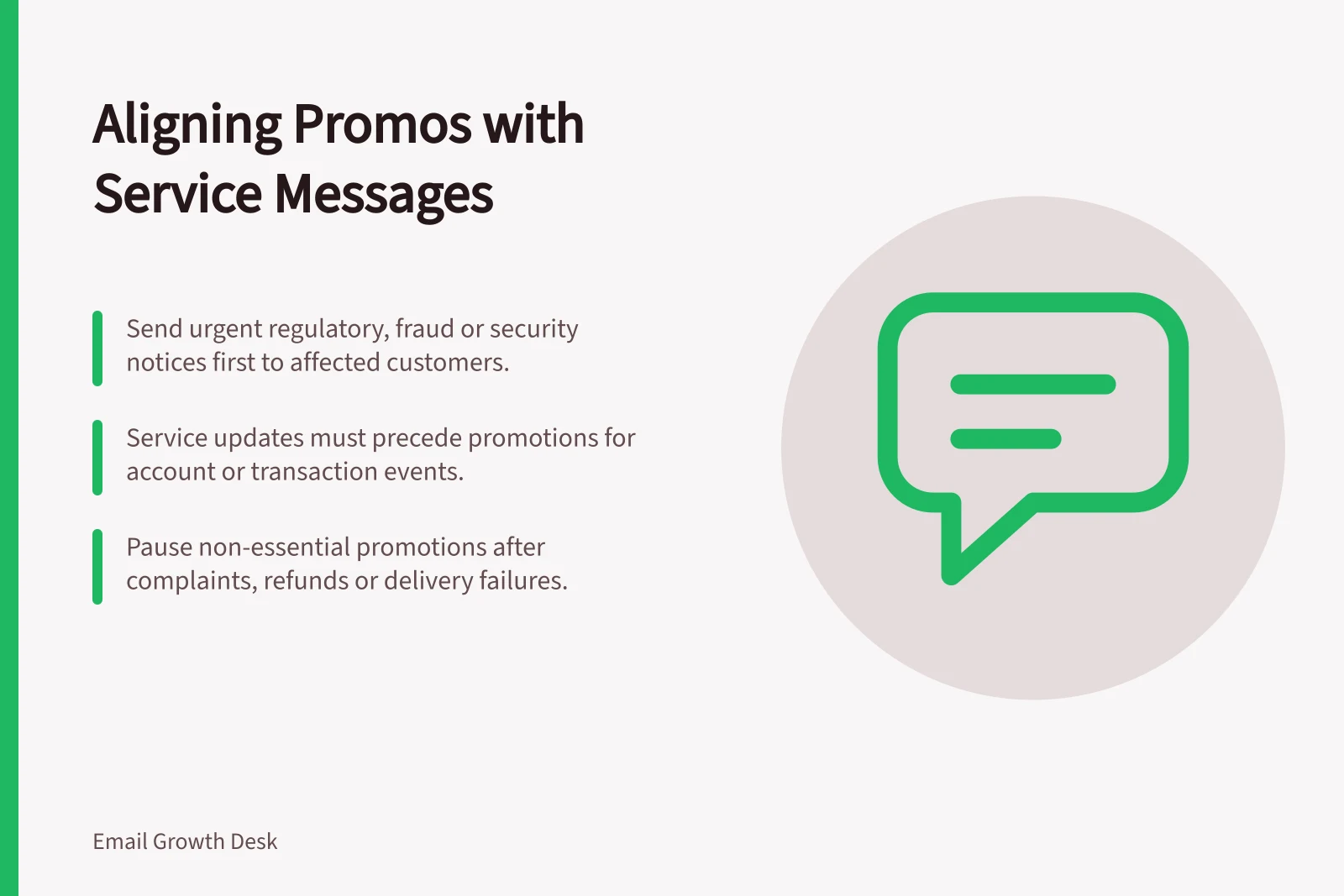
Use this precedence: first send urgent regulatory, fraud, security or operational notices to the affected customers; next send the service update needed for a transaction or account event; send promotion only when it will not obscure those notices, no pause applies and permission is valid. This makes service delivery the priority without treating a service notice as a marketing opportunity.
For an order delay, put the clear operational update before any offer and never let a campaign suppression rule stop the essential notice. A recent complaint, refund or delivery failure may pause non-essential promotion to the affected customer until the issue is resolved, while the service message still goes to the people who need it.
The Spam Act 2003 (Cth) sets rules for commercial electronic messages, including consent requirements. A designated commercial electronic message can consist of no more than factual information; a service label alone does not determine classification, and an embedded offer is promotional content rather than factual information.
Before including promotional content in a service message, check its classification and permissions against the Spam Act 2003 (Cth) and ACMA (Australian Communications and Media Authority) guidance. For commercial electronic messages, check consent, sender identity and contact details, and an unsubscribe facility; the unsubscribe requirement does not apply to designated factual messages.
Assign a CRM owner to maintain the shared calendar and precedence rules, the service team to maintain operational event triggers, and legal or compliance to approve classification and permissions. Have deliverability check send routing and suppression behaviour before release.
Keep service and promotional messages on distinct send paths, with a central suppression list controlling promotional sends. Do not apply a marketing suppression rule to an essential service notice; record consent and unsubscribe status so promotional messages go only to recipients whose permissions allow them.
Test the rule with fictional customer journeys, including an order delay and an active complaint, refund or delivery failure. Check that the required service message still sends and that promotion remains paused where the rule says it should.
Review the combined inbox experience, not just each team's send performance. Confirm that the service update remains prominent and that promotional content does not bury or contradict it.
Priority Sequence for Sending Messages
- Urgent Regulatory, Fraud, Security or Operational NoticesSent immediately to affected customers; non-negotiable priority.
- Service Updates for Transactions or Account EventsDelivered next to ensure transparency and compliance.
- Promotional MessagesOnly sent when no urgent service message is pending and consent is valid.
Service Messages vs Promotional Messages: Key Differences
- Purpose
- Inform about transactions, account status, compliance or security
- Content Type
- Factual, transactional, regulatory – no embedded offers
- Timing Priority
- Highest priority – must not be delayed or suppressed
- Promotional Content
- Prohibited in service messages unless properly classified and permitted
- Compliance Authority
- ACMA (Australian Communications and Media Authority)