Email Copy
Campaign emails versus transactional messages
Distinguish campaign emails from service messages and assess mixed-purpose content under Australian spam rules.
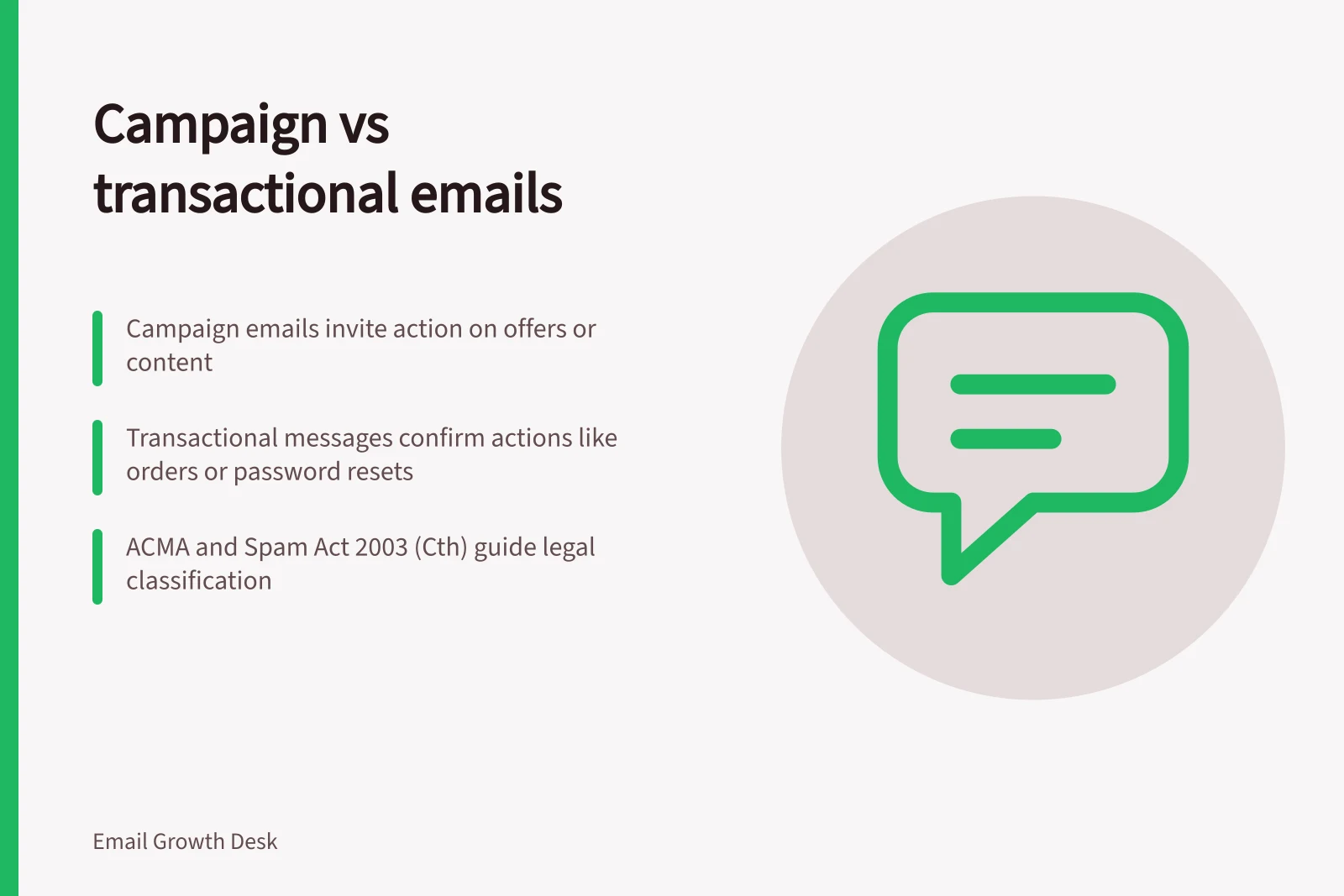
A campaign email invites an audience to read or act on content or an offer. A transactional message gives information tied to an action or account event, such as an order confirmation or password reset.
These are practical purpose labels, not a substitute for the Australian legal category. The Spam Act 2003 (Cth) regulates commercial electronic messages, so a service trigger alone does not settle whether an email falls within that category.
For Australian guidance, consult the Australian Communications and Media Authority (ACMA), including its Avoid sending spam guidance. Use the Spam Act 2003 (Cth) as the legal frame for the distinction.
Start with the reason it is sent
Ask what triggers the message and what the recipient needs from it. A purchase or account request points to a service purpose, while an invitation to read or act on an offer points to a campaign purpose.
| Message | Main job | Check before sending |
|---|---|---|
| Newsletter or sale announcement | Invite an audience to read or act | Can these recipients receive this marketing? |
| Order confirmation | Confirm a purchase | Is the order information accurate? |
| Password reset | Help someone complete an account request | Is the action relevant to that request? |
| Order update with an added offer | Give a service update and promote something else | Has the whole message, including links, been assessed as commercial? |
For the marketing check, identify express or inferred consent; mere publication of an email address does not by itself establish inferred consent. The Act also recognises designated commercial electronic messages consisting of no more than factual information, which it does not prohibit sending.
These are planning examples, not legal findings. A message sent to one person can promote a product, and a service notice can go to many affected customers.
Campaign Emails vs Transactional Messages: Key Differences
- Purpose
- Invite audience to read or act on content/offer
- Trigger
- User action (e.g. purchase, account request)
- Example
- Newsletter, sale announcement, product promotion
- Consent Requirement
- Express or inferred consent required
- Service Message Example
- Order confirmation, password reset, account update
- Consent for Marketing
- Separate from service purpose; not automatically granted
- Spam Act 2003 (Cth) Compliance
- Must include functional unsubscribe and accurate sender info
ACMA Enforcement Actions in Australia (2026)
- Key Breach Type
- Unauthorised spam messages with misleading links
- Investigation Focus
- Mixed-purpose emails misclassified as transactional
- Common Mistake
- Using account triggers to send marketing without consent
Keep service information clear
Put the order, account or requested action first, and explain what the person should do if something is wrong. Check any proposed offer, banner or link in the final message rather than relying on a service template.
An email platform label is a sorting aid, not a legal classification. An order or account trigger does not settle whether a mixed-purpose email is a commercial electronic message, so check the whole message as it will be sent.
Keep marketing preferences separate
Keep marketing subscription status separate from the information needed to send an order or account update. Honour a marketing unsubscribe across marketing workflows.
An address given to handle a specific request is not automatically permission to market to that person. Check for express or inferred consent before treating it as a basis for a promotion.
Assess a service message on its own content and purpose, especially if anyone adds a promotion.
Review the final version
A useful editorial question is: “Would this message still serve the recipient's transaction or request if the promotional material were removed?” Preserve the necessary service information, then assess any proposed promotion and its links.
It is an editorial prompt, not a legal test. The Australian legal category to check is whether the final email is a commercial electronic message under the Spam Act.
For a commercial electronic message, check consent, accurate sender information and a functional unsubscribe. The Act does not prohibit designated commercial electronic messages consisting of no more than factual information.
Record the version assessed. Recheck it after changes.