Campaign Operations
Email marketing for Australian businesses
Start an Australian email programme with clear goals, consent records, useful messages and honest measurement.
Start an email programme with one defined audience, a clear reason to write and a way to check whether the message helped. Before scheduling a send, establish which recipients can receive marketing, what they were told to expect and how unsubscribes will be honoured.
Give each email a job
A newsletter might help subscribers use a product. A campaign might invite them to an event. An order confirmation tells a customer what happened to a purchase. These messages need different content and handling, even on the same sending platform.
Write the purpose as a reader outcome. “Help subscribers choose a suitable workshop” guides the invitation more clearly than “increase engagement”. Include details needed to act, such as the date, conditions and booking route.
Keep order information accurate and easy to find. Review any promotion added to a service message, and keep service information distinct from sales content.
Establish permission and expectations
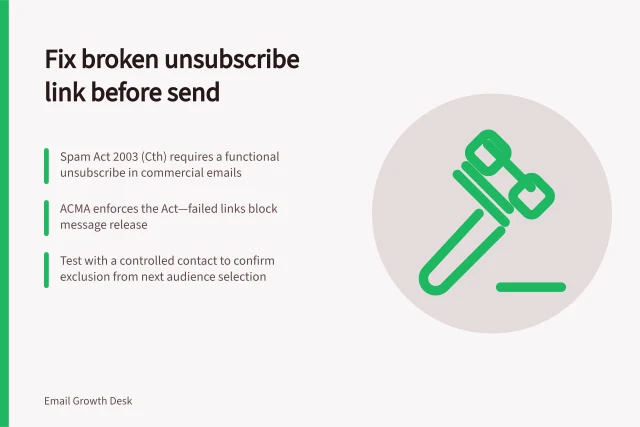
For commercial email with an Australian link, the Spam Act 2003 (Cth) requires consent, clear sender identification and a functional unsubscribe mechanism. Consent may be express or inferred; record the basis and keep evidence. Identify the sender accurately in each message.
Make the unsubscribe route clear and plan to action requests within five business days. Keep it functional so recipients can use it to withdraw consent.
At signup, describe what the person will receive in words they would recognise. “Monthly repair advice and workshop dates” sets a clearer expectation than “updates”.
The Privacy Act 1988 (Cth) and Australian Privacy Principles also concern how personal information is handled. APP 7 covers direct marketing and APP 8 overseas disclosure; collect only what is needed and keep it secure.
Decide where consent and unsubscribe records live. Before importing contacts or scheduling a campaign, check that a change reaches every workflow that sends marketing.
An ACMA article dated March 2026 reports that Lululemon was penalised $702,000 for spam breaches. Treat permission, sender identification and unsubscribe handling as operating checks, not just copy-review items.
Choose a message and cadence you can sustain
Start with one recurring reason to write. A retailer might offer product-care advice; a service business might answer preparation questions before an appointment.
Outline several issues before promising a frequency. If useful topics are hard to find, choose a lighter schedule. Coordinate campaigns with automated emails and service notices so recipients do not receive conflicting information.
Use the signup promise as a cadence guide. If it says “Monthly repair advice and workshop dates”, plan around that monthly expectation. Tell subscribers if the schedule changes.
Make the next action clear
Put the main point early. Use an accurate subject line and an action label that names the destination. Place important conditions near the action, and keep essential facts readable when images do not load.
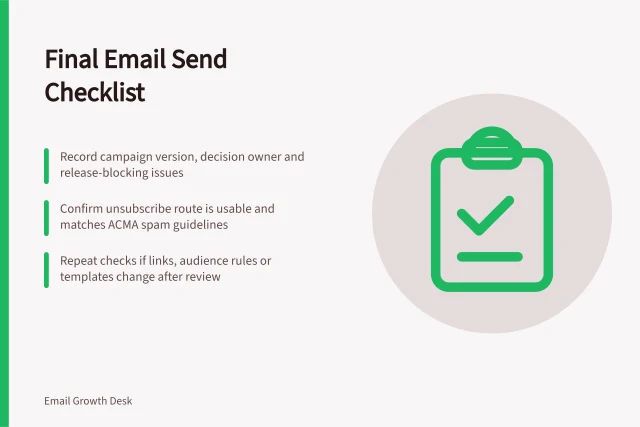
Review the final version before sending. Check recipients and exclusions, dates, claims, links, personalisation, sender details and the unsubscribe route. Hold a send if a material claim, audience rule or main destination remains unresolved.
Measure the email’s purpose
Choose a result that matches the message. For an invitation, completed bookings may be useful if they can be reliably connected to the campaign. If only the booking-page link is tracked, report clicks rather than bookings.
Keep sent and delivery counts beside the outcome, and use a consistent counting rule when comparing sends.
Open and click reports can help diagnose a message, but they do not reliably measure human attention. Image loading, Apple Mail Privacy Protection (MPP) and automated security activity can affect those figures.
Review relevant actions, unsubscribes and complaints too. If people click but do not complete the intended action, examine the destination and offer as well as the email.
In this guide
- Campaign emails versus transactional messagesDistinguish campaign emails from service messages and assess mixed-purpose content under Australian spam rules.
- Choosing an email programme goal that can be measuredChoose an email goal tied to an observable action, define its counting rule and report results within the data's limits.
- Planning a newsletter around a clear reader promiseDefine a newsletter promise, plan repeatable issues and keep signup wording aligned with what subscribers receive.