Segmentation
Part of Email campaign calendars and frequency
Detecting fatigue before unsubscribes rise
Unsubscribes often appear after relevance has already weakened.
Unsubscribes often appear after relevance has already weakened. Earlier cohort signals can reveal fatigue before exits climb.
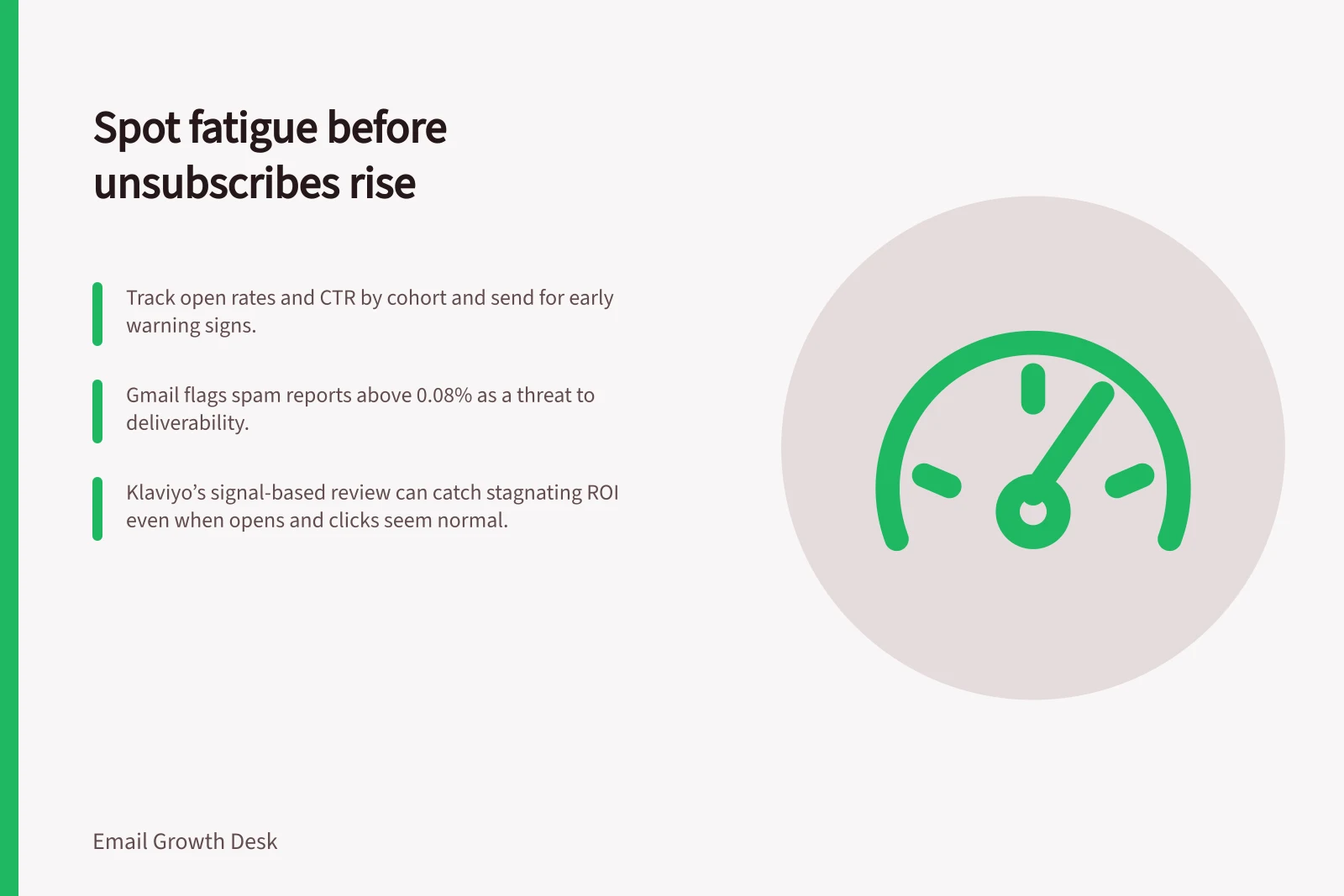
Track open rates, click-through rates (CTR), unsubscriptions and spam complaints by cohort and send. A steady decline in opens over weeks or months, falling CTR even when opens hold, or a spike in unsubscriptions or spam complaints tied to a send are warning signs.
Gmail guidelines treat spam-report levels above 0.08% as a threat to sender reputation and deliverability. Use this as a warning, not a target.
Klaviyo’s signal-based review can help surface exits from flows before conversion, rising bounce or suppression rates, and revenue from flows going flat. Stagnating or negative ROI can appear even when open and click metrics look normal.
Compare similar audiences across time and campaign type, and assess cohorts separately. Include newly subscribed and long-inactive people rather than relying on whole-list averages.
Open data can be noisy, so use it as context rather than the sole fatigue measure. Also note repeated sends without response and a growing share of people contacted repeatedly without response; interpret these alongside click, unsubscribe and complaint signals.
Record how many emails contacts receive per week alongside their engagement. Marketing pressure is the volume and cadence of messages over a period, and there is no single ideal cadence for every recipient.
Inspect the recent message sequence for a sample of recipients. Did they receive overlapping promotions, a reminder after completing the task or repeated offers for an irrelevant category?
Correct those causes before simply changing subject lines. A frequency comparison can help diagnose pressure, but it is not a general send-planning rule.
Test a lower frequency or a narrower topic for a defined segment while keeping permission and audience rules constant. Measure useful response per recipient over the defined test period, not only per email.
If fewer sends produce similar orders with fewer complaints, the test suggests the previous contact pressure may have been unnecessary. If results are inconclusive, keep the conclusion modest and continue observing.