Segmentation
Part of Email list segmentation for campaigns
Testing whether a segment needs a different message
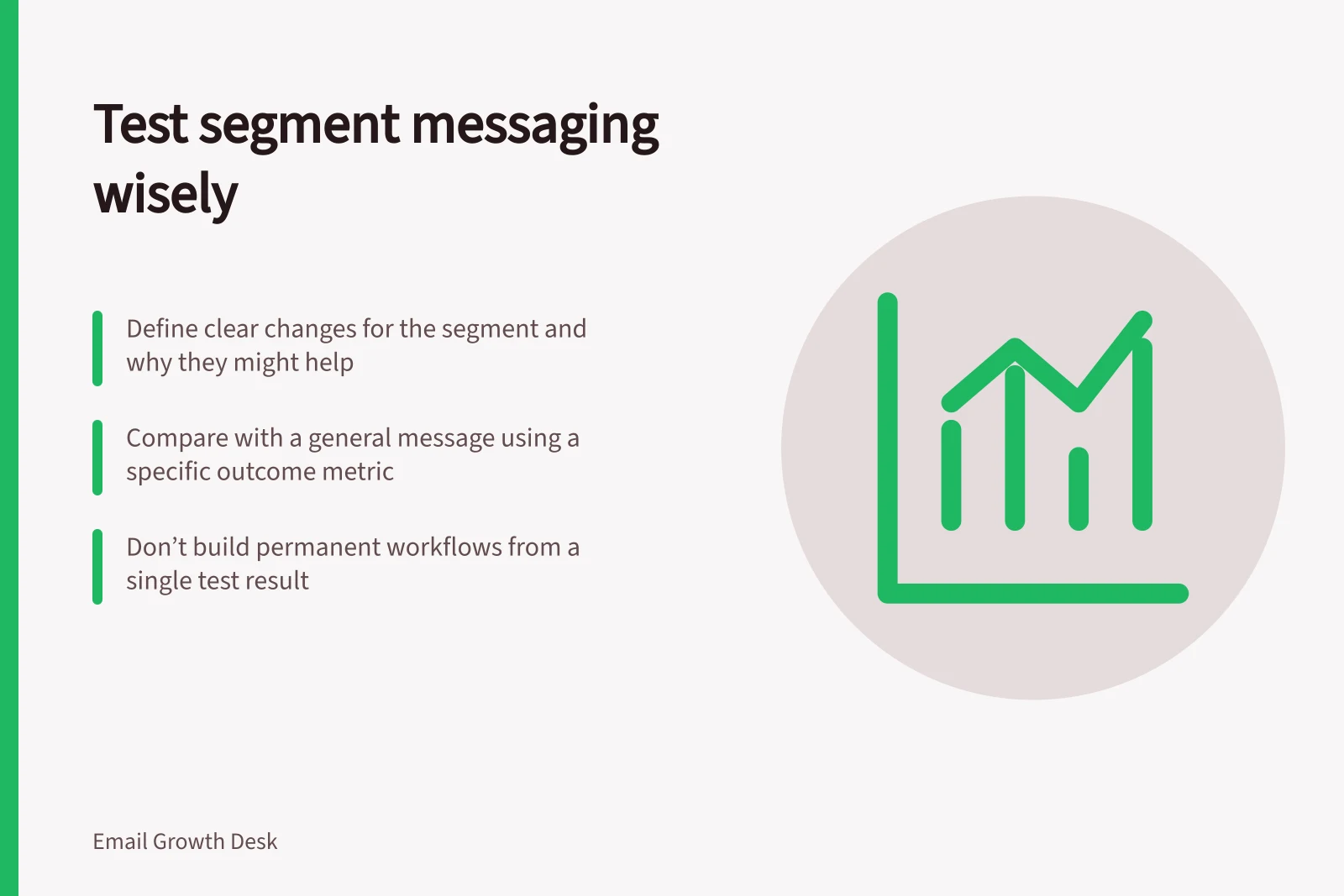
Test a segment-specific email only when you can state what changes for that group and why it might help.
Test a segment-specific email only when you can state what changes for that group and why it might help. Compare it with a reasonable general message, choose a useful outcome in advance, and avoid treating a single noisy result as proof that the segment deserves a permanent workflow.
Write the hypothesis in plain language
For example: "People who chose repair updates may be more likely to use a maintenance guide when the opening names their equipment type." The interest and the different content are clear. "Personalisation improves engagement" is too broad to tell a writer what to create or an analyst what to measure.
Keep the audience definition stable during the test. If it combines interest, recent purchase and activity, document each condition.
Compare a meaningful change
Change the message element that follows from the segment hypothesis, such as examples, explanation or offer relevance. Keep the rest of the campaign as steady as practical: send window, destination and eligibility. If both audience and offer change at once, the outcome is hard to interpret.
Choose a metric tied to the message's job. A maintenance guide might be judged by useful guide visits or support task completion, if those can be measured. Opens alone are a weak proxy for whether the content helped. The number of people in the segment and the natural variability of results matter; a small list can swing sharply between sends.
Make a decision after the test
Record the version sent, audience rule, dates, outcome and any unusual promotion or external event. If the segment version performs better, repeat or extend the check before building a complex recurring programme. If it does not, inspect whether the content actually reflected the preference before abandoning the segment.
Do not claim a test was run because the email tool has an A/B feature. The decision is whether a distinct message reliably adds value for readers and justifies the ongoing work to maintain its data and content.